Eleven platforms. Eleven completely different deals.
Some pay you a flat hourly rate and call you an employee. Some hand you insurance clients and take a cut. Some don't pay you anything directly they just get you in front of people who will.
The best online platform for therapists in 2026 isn't the one with the biggest name. It's the one that matches how much control you want over your rates, your schedule, and your client relationships against how much administrative work you're willing to hand off in exchange. This guide breaks down all 11, side by side, so you can actually compare them instead of reading eleven separate sales pages.
One thing before we start: "best" here doesn't mean best patient reviews. It means best for you, the therapist reach, payout, and how much say you get over your own rates. Those three things trade off against each other constantly, and every platform on this list sits in a different spot on that spectrum.
Quick-Look Comparison
| Platform | Employment Type | Pay | Credentialing Time | Control Over Rates |
|---|---|---|---|---|
| Talkspace | 1099 contractor | $70–$90/60-min session (by client zone) | Days to ~2 weeks | Low zone-based rates |
| Grow Therapy | 1099 contractor | Per session, insurance-negotiated | 5–7 days to first payor; full panel up to 2+ months | Low Grow negotiates payor rates |
| BetterHelp | 1099 contractor | $30–$70/hr live (tiered by weekly hours) | Days (case study + interview) | Low BetterHelp sets the pay scale |
| Alma | Membership ($125/mo) | Private-pay rate + Alma-negotiated insurance rates | Under 45 days | Medium you keep private-pay control |
| Rula | 1099 contractor | ~$80/hourly session (varies) | ~3 weeks | Low set via payor contracts |
| Thriveworks | W2 employee | ~$80K–$105K/yr salary | Standard employee onboarding | None salaried |
| Amwell | Contracted medical group provider | Varies by business line/visit type | 5–10 business days | Low |
| Teladoc Health | 1099 contractor | ~$65/hr flat (varies by posting) | Standard licensure verification | Low |
| Headway | Free, contractor-style | Enhanced negotiated rates, paid biweekly | As little as 30 days per plan | Low |
| Open Path Collective | Free membership | You set rate within $40–$70/session band | ~2 business days review | High within the band, it's your rate |
| Brightside Health | 1099 contractor | ~$74/hr average reported | 2–4 weeks, mostly async | Low |
Rates and timelines shift as payor contracts and platform policies change treat this table as a snapshot, not a guarantee, and confirm current numbers directly with each platform before applying.
Now let's go through each one properly.
1. Talkspace
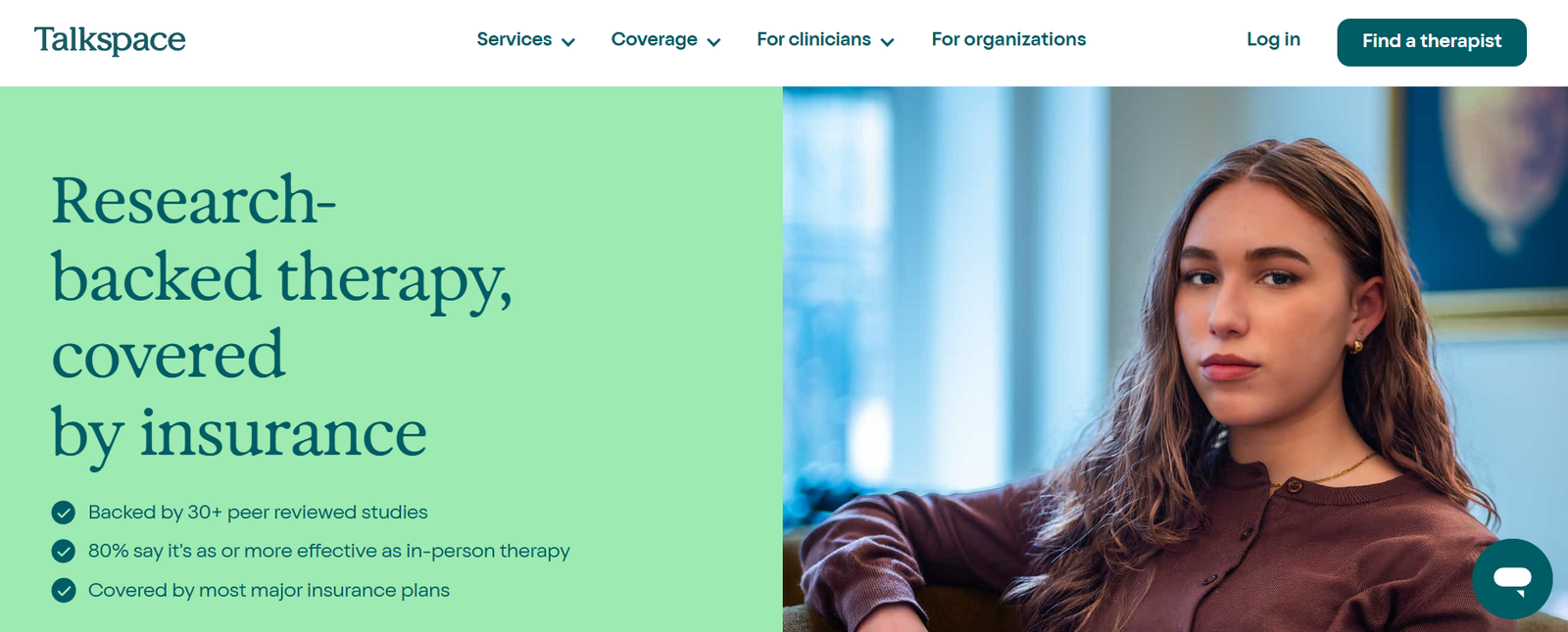
Positioning: The largest name in the space, built on messaging-plus-video therapy with a huge insurance-backed client base.
Quick-look: 1099 contractor · $70–$90 per 60-minute live session by client zone · credentialing in days to about two weeks · low control over rates.
How to get listed: Apply through Talkspace's provider portal. Submit your license and malpractice documentation, complete onboarding training on the platform itself, and you're eligible to start seeing clients.
Requirements: An independent, state-board-approved clinical license (LPC, LMHC, LCSW, LMFT) and your own professional malpractice liability insurance.
What you get paid: Live sessions pay by client location zone $90 for Zone 1 (California), $78 for Zone 2 (DC, MA, MD, NY, VA, WA), and $70 for Zone 3 (everywhere else). 30- and 45-minute sessions are prorated. Asynchronous messaging pays separately and fluctuates.
Pros for therapists: No caseload requirement and no non-compete clause, so you can run Talkspace alongside your own practice. Talkspace handles referrals, billing, and insurance claims.
Cons for therapists: Zone-based pay means two therapists doing identical work can earn different rates based purely on where their clients live. No room to negotiate.
2. Grow Therapy

Positioning: A free, hands-off insurance credentialing and directory platform built specifically to get you paneled fast.
Quick-look: 1099 contractor · per-session, insurance-negotiated pay · 5–7 days to your first payor (full panel can take 2+ months) · low control over rates.
How to get listed: Complete an application call to confirm fit, then finish onboarding to get credentialed with your first payor. Once you're in-network with one payor, you get portal access and can start seeing clients.
Requirements: An active, unrestricted state license and your own malpractice insurance. Grow automatically enrolls you with contracted payors relevant to your license and location.
What you get paid: Paid weekly, per session. Grow negotiates the insurance contracts on your behalf, so you don't set the rate but you also don't have to negotiate with insurers yourself.
Pros for therapists: Genuinely free to join. Credentialing is close to hands-off, and Grow keeps working to add you to more payors after your first one clears. Includes basic EHR and telehealth tools.
Cons for therapists: Some payors take far longer than the average 5–7 days occasionally past six months. You're locked into whatever rates Grow has negotiated with each insurer.
Also Read: How to Create a Psychology Today Profile | Step By Step →3. BetterHelp
Positioning: The consumer household name subscription-based therapy, largely message-driven, at serious scale.
Quick-look: 1099 contractor · $30–$70/hour for live sessions depending on weekly hours, plus per-word messaging pay · screening takes days · low control over rates.
How to get listed: Apply online, then complete a case study and video interview as part of screening.
Requirements: U.S. residency, an active state counseling license (LCSW, LMFT, LPC, PsyD, or equivalent), and per BetterHelp's own listed requirement around 1,000 hours of hands-on counseling experience.
What you get paid: Live sessions run on a sliding weekly scale: work 5 hours a week and you earn $30/hour; every additional 5 hours adds roughly $5/hour, up to about $70/hour at a full 35–40 hour week. Messaging pays per word, commonly reported between $0.25 and $0.30. Some current postings advertise $43–$59/hour with an insurance-session bump of up to 33% more.
Pros for therapists: Enormous, steady client pool. No need to market yourself or chase billing.
Cons for therapists: The weekly-hours pay scale punishes anyone who wants a lighter caseload take a week off and you drop tiers. Messaging pay, calculated honestly against the time it takes to write a thoughtful reply, often works out below the live-session rate.
4. Alma

Positioning: Less a "platform," more a membership that hands you the tech stack of a private practice EHR, telehealth, credentialing, directory for a flat monthly fee.
Quick-look: Membership model, not employment · $125/month (or roughly $95/month billed annually) · credentialed with major payors in under 45 days · medium control over rates.
How to get listed: Apply for Alma membership. Once approved, Alma credentials you under its own payer contracts.
Requirements: An active clinical license. You're still running your own practice Alma is infrastructure, not an employer.
What you get paid: You keep your own private-pay rate for cash clients. For insurance clients, Alma's negotiated contracts often land $10–$30 higher per session than a therapist could get credentialing solo but you don't set that number yourself.
Pros for therapists: One membership fee replaces separate EHR, credentialing service, and directory listing costs that would otherwise run $300–$500+ a month combined. Access to a community of roughly 30,000 providers and free CE.
Cons for therapists: It's a real monthly cost even in a slow month. Some therapists have flagged discomfort with Alma's own EHR given its investors overlap with its insurance partners worth reading the privacy terms yourself.
5. Rula

Positioning: An insurance-matching platform that promises full clinical autonomy though provider reviews on that point are mixed.
Quick-look: 1099 contractor (officially) · roughly $80 per hourly session, varies by license and market · about 3 weeks to credential · low control over rates.
How to get listed: Fill out a "get started" form, complete an extensive profile covering license history, education, and specialties, then go through Rula's credentialing process with its insurance partners.
Requirements: Licensure as an LMFT, LCSW, LPCC, or licensed psychologist, active in at least one U.S. state, and your own malpractice liability insurance.
What you get paid: Session rates are set by Rula based on its current payor contracts, paid every two weeks by direct deposit. No caseload minimum.
Pros for therapists: Rula handles marketing, insurance verification, billing, and EHR genuinely comprehensive admin support. Fills caseloads quickly by most accounts.
Cons for therapists: This is the platform where the gap between the official pitch and the on-the-ground experience is widest. Multiple therapist reviews describe close monitoring of session notes and timing, and no room to negotiate hourly rates closer in feel to a W2 job than the "complete autonomy" language suggests, despite the 1099 classification.
6. Thriveworks
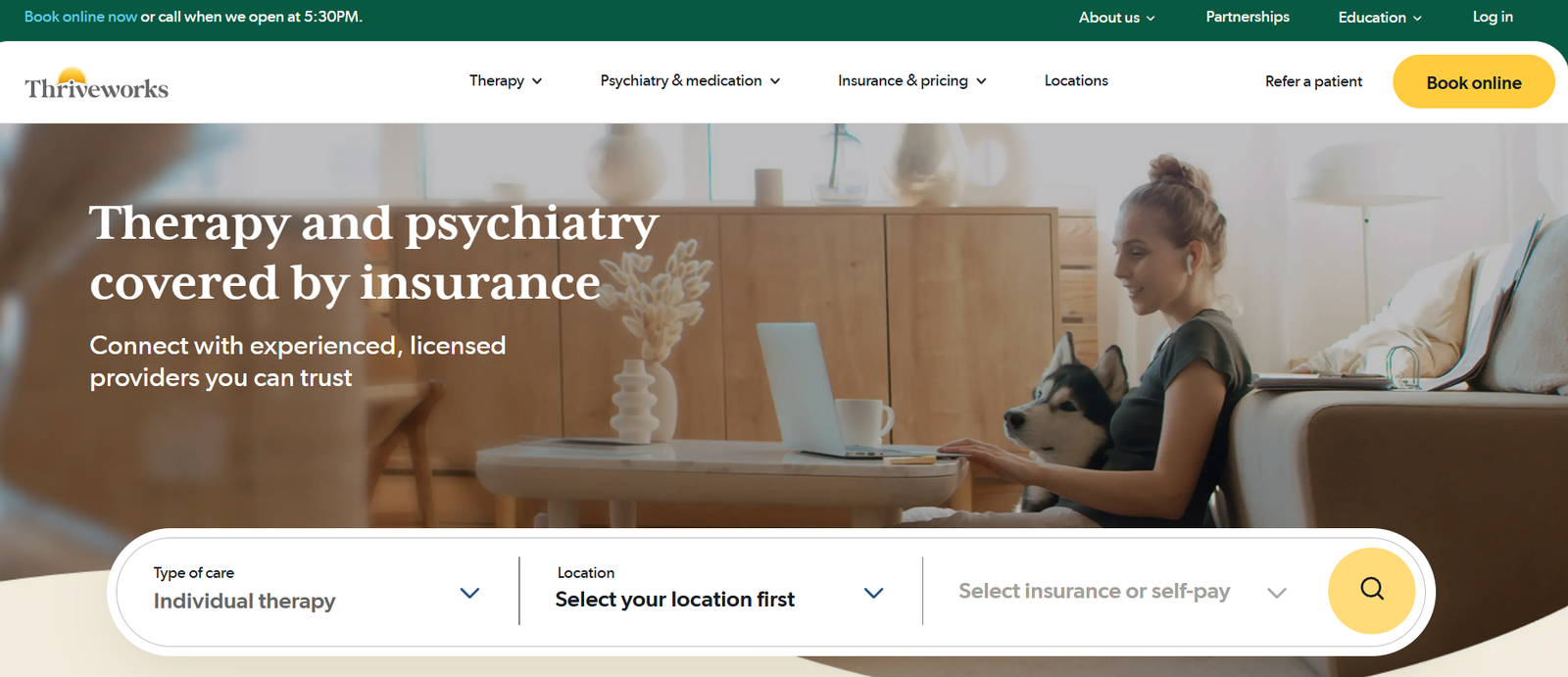
Positioning: The one genuine W2 option on this list a real employer, not a marketplace.
Quick-look: W2 employee · roughly $80,000–$105,000/year depending on license and role · standard employee onboarding · no control over rates (salaried).
How to get listed: Apply directly for a therapist position, same as any employed clinical role resume, interview, offer.
Requirements: Active clinical license matching an open role (LCSW, LMHC, LMFT, etc.). Standard employment background checks apply.
What you get paid: Salary bands vary by license: LCSW roles report around $80K/year, Licensed Mental Health Counselor roles closer to $105K/year, and PMHNP roles considerably higher. Paid on a regular payroll schedule with the tax handling that comes with W2 status.
Pros for therapists: Predictable income regardless of a slow week. Benefits, an EHR platform already built, and no billing to manage yourself.
Cons for therapists: Multiple employee reviews mention feeling locked to a full billable-hours target a late-arriving client doesn't shrink your obligation. Compensation satisfaction ratings on employer review sites run notably low for this reason.
7. Amwell

Positioning: A national, physician-owned virtual medical group with a dedicated behavioral health line, serving referrals from health plans, employers, and health systems.
Quick-look: Contracted medical group provider · pay varies by business line and visit type · credentialing in 5–10 business days · low control over rates.
How to get listed: Complete Amwell Medical Group's self-enrollment credentialing application the company advertises it as a roughly 15-minute form.
Requirements: Independent licensure (LCSW, LMFT, LPC, PsyD, or similar), single- or multi-state license eligibility, and willingness to complete Amwell's virtual-care training program.
What you get paid: Pay is determined by business line and visit type rather than a single flat rate. Amwell also provides malpractice coverage up to $1M per incident and $3M per year, with indefinite tail coverage.
Pros for therapists: Backed by health plan and health system referral volume, not just direct-to-consumer marketing. Structured training on "webside manner" and platform use.
Cons for therapists: Less publicly transparent about exact pay figures than most competitors on this list you'll need to get further into the application process to see real numbers.
8. Teladoc Health

Positioning: The telehealth giant that also owns BetterHelp, running its own separate 1099 mental health therapist network for health-plan-referred clients.
Quick-look: 1099 contractor · roughly $65/hour flat in current postings (varies) · standard licensure verification · low control over rates.
How to get listed: Apply to an open Mental Health Therapist (1099) posting for your state; complete licensure and background verification.
Requirements: Active license (LCSW, LMFT, or LPCC), a master's degree or higher in a relevant field, and the ability to work in a fully unsupervised, independent capacity.
What you get paid: Current postings list a flat $65/hour rate, though this varies by posting and state. You're not billing insurance yourself Teladoc handles that.
Pros for therapists: Full schedule autonomy and no supervision requirement. Backed by a large, established telehealth infrastructure.
Cons for therapists: Therapist reviews describe required ongoing training modules with no separate pay for completing them, and note the platform feels more built around physicians and psychiatrists than therapists specifically.
9. Headway
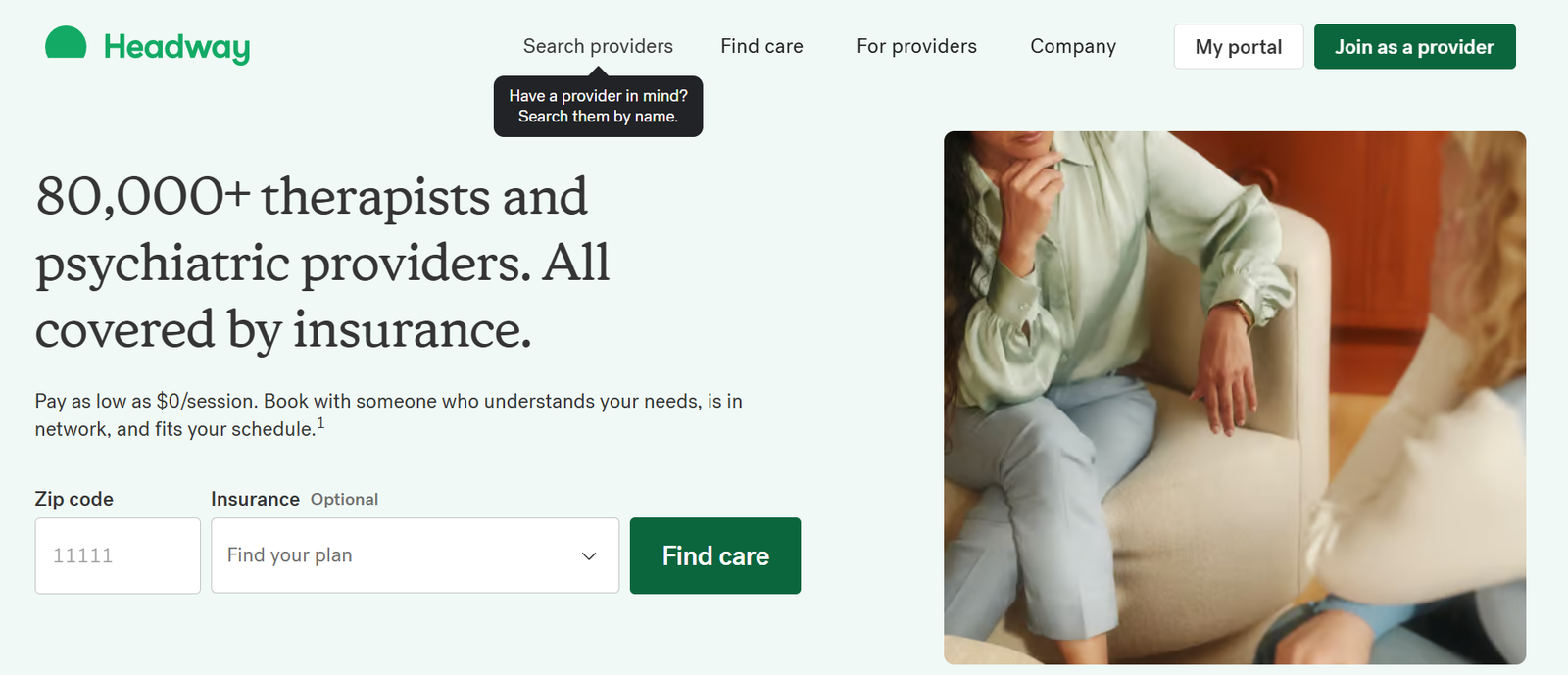
Positioning: A free insurance credentialing and billing platform that makes its money from insurers, not from you.
Quick-look: Free, contractor-style · enhanced negotiated rates, paid biweekly · credentialing in as little as 30 days per plan · low control over rates.
How to get listed: Submit a form with your license and location details; a Headway practice consultant follows up to complete credentialing.
Requirements: An active, independent clinical license. No fees, no subscription, ever, for providers.
What you get paid: Paid on the 15th and last day of each month. Headway negotiates rates with major payors UnitedHealthcare, Aetna, Cigna, Oxford, Oscar, Anthem using leverage from its scale (80,000+ providers), which several therapists report yields better per-session rates than they got credentialing solo.
Pros for therapists: Zero cost to join or maintain. Multi-state credentialing available if you're licensed in more than one state. Includes clawback protection if a claim gets denied after the fact.
Cons for therapists: The provider directory has gotten crowded enough that some therapists report very few direct client referrals from it worth treating as a billing tool first, marketing channel second.
10. Open Path Collective
Positioning: A nonprofit sliding-scale network, not an insurance platform clients pay cash, at a reduced rate, directly to you.
Quick-look: Free membership for therapists · you set your own rate within a $40–$70 per-session band · application reviewed in about 2 business days · high control over rates, within that band.
How to get listed: Submit a therapist application through Open Path's site. Staff review it, typically within two business days.
Requirements: Active licensure (pre-licensed and intern therapists are also eligible at a separate rate tier). Agreement to see at least one Open Path client at the reduced rate.
What you get paid: Directly from the client, in cash, at whatever rate you set within Open Path's $40–$70 individual session band ($40–$80 for couples/family, $30 flat for student interns). There's no insurance billing at all this is a private-pay-only model.
Pros for therapists: Free professional profile, free referrals, and free basic marketing. Actual rate-setting freedom within the band more than almost anything else on this list.
Cons for therapists: Rates are capped well below typical market pricing by design, since the whole model exists to serve clients who can't afford full fee. Only makes sense as a supplement to a broader caseload, not a full practice on its own.
11. Brightside Health

Positioning: A telehealth platform specializing in evidence-based, measurement-driven care for anxiety and depression, with additional programs for suicide prevention and teen care.
Quick-look: 1099 contractor · roughly $74/hour average reported · onboarding in 2–4 weeks, mostly asynchronous · low control over rates.
How to get listed: Apply to an open remote therapist role; onboarding is largely self-paced and asynchronous.
Requirements: A master's or doctorate in clinical psychology, social work, or counseling from an accredited program, plus an active state license.
What you get paid: Reported average pay runs around $74/hour described by several reviewers as above average for a 1099 arrangement in this space. Malpractice coverage and free CEUs are included.
Pros for therapists: Specialized clinical opportunities Suicide Prevention (with free CAMS training), Teen Therapy, and IOP programs for therapists who want that focus. AI-assisted, HIPAA-compliant documentation tools built in.
Cons for therapists: The clinical focus is narrower than a general practice you're primarily treating anxiety and depression within a measurement-based model, which won't suit every therapist's style or specialty.
Platform vs. Your Own Website
Here's the trade-off nobody puts in the recruiting pitch.
Join a platform, and you get referrals without lifting a finger. You give up something in return: the client relationship technically belongs to the platform, not you. BetterHelp's algorithm decides who you see. Rula and Talkspace route clients based on their own matching logic. If you ever leave, that client list doesn't come with you.
Many therapists on this list also keep a free Psychology Today profile listing running alongside a platform, precisely because directory presence and platform presence solve different problems.
The catch: a website only works if people can find it. That means custom website design for therapists built around actual search intent, not just a nice-looking page nobody visits.
What you keep with your own site: full control over pricing, positioning, and the client relationship long-term. What you give up: the built-in referral volume a platform hands you from day one.
Most therapists who are doing this well don't pick one side. They run a platform or two for volume and predictability, and build a website in parallel for the clients they want to own outright. If you want a sense of what that actually looks like in practice, it's worth browsing some real therapist website examples before deciding what yours should look like.
How to Choose
Eleven platforms boil down to five real models. Pick the model first the specific platform is a second-order decision.
Talkspace, BetterHelp, Teladoc, Brightside. High client volume, low control over rates, minimal admin. Good if you want to fill gaps in your schedule fast and don't mind the platform setting your pay.
Grow Therapy, Headway. Free to join, insurance-negotiated rates you don't set yourself, but zero out-of-pocket cost and genuinely fast paneling. Good for therapists who want insurance clients without the credentialing headache.
Alma, Open Path Collective. You keep either your private-pay rate or full rate-setting freedom within a band. Costs you either a monthly fee or nothing, but you're still fundamentally running your own practice underneath it.
Thriveworks. Actual salary, actual benefits, zero rate-setting or billing responsibility and zero upside if your caseload runs light or your value to the market goes up.
Rula, Amwell. Marketed as autonomous, but closer to managed care in practice. Good admin support, less actual independence than the pitch suggests.
If you're running more than one of these at once which most therapists eventually do a piece of therapy practice management software that isn't tied to any single platform becomes worth the cost fast. Trying to track separate schedules, notes, and billing across three platforms in your head doesn't scale.
And regardless of which model you land on, the goal is the same: get more therapy clients through a mix of channels, not dependence on any single one.
Frequently Asked Questions
Eleven platforms, five real models, and the right one depends entirely on what you're optimizing for right now. If you'd rather have a real conversation about which combination fits your specific caseload, licensing, and growth goals, get in touch with our team we work with therapists building exactly this kind of practice every day.