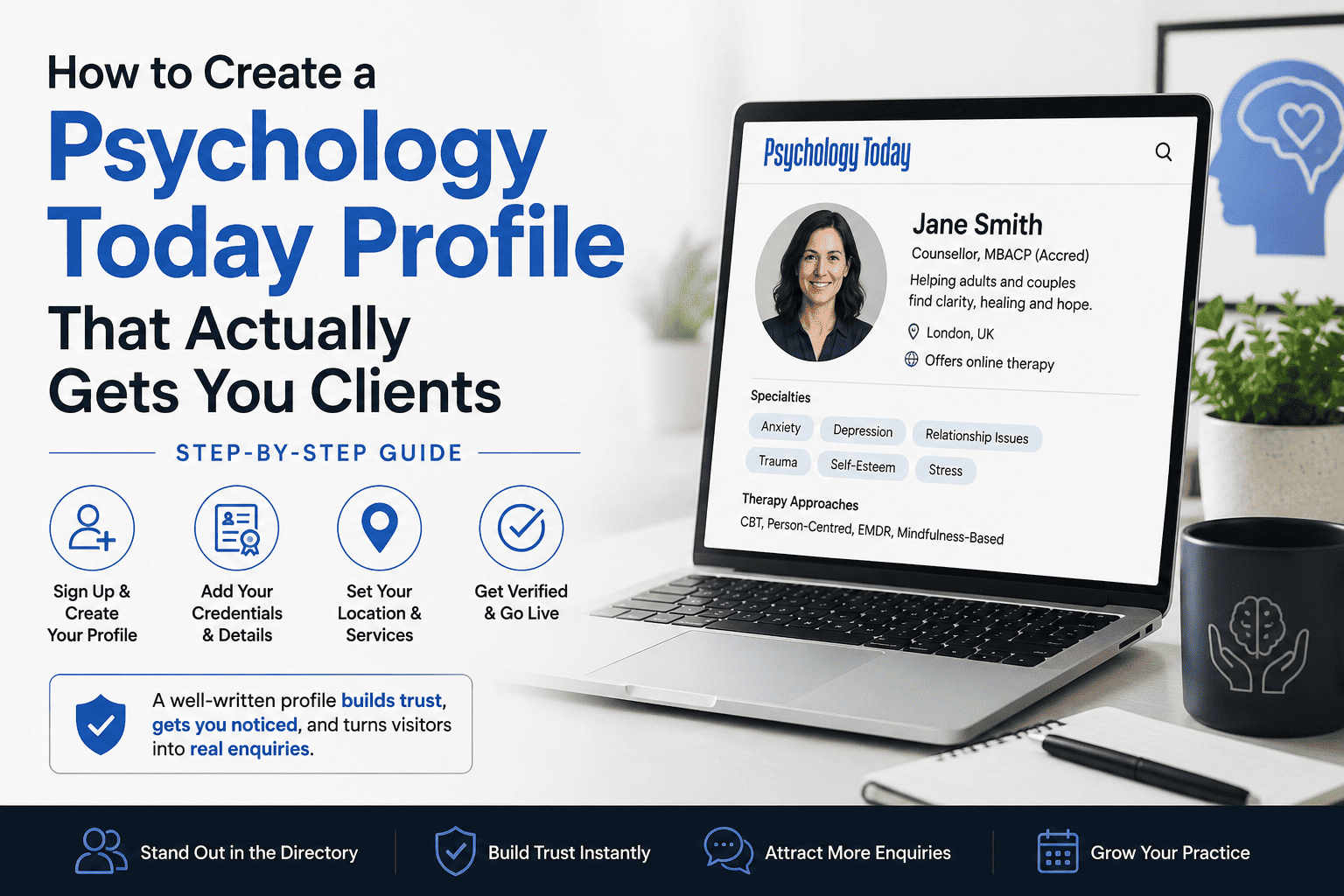
Creating a Psychology Today profile sounds simple. And technically, it is.
But here's the problem most therapists run into: they set up their profile in 20 minutes, hit publish and then wait. And wait. And barely hear a thing.
Not because Psychology Today doesn't work. But because their profile wasn't set up to work for them.
In this guide, you'll learn exactly how to create a Psychology Today profile from scratch and how to write it in a way that gets you noticed, builds trust, and turns visitors into actual enquiries.
What You Need Before You Sign Up
Don't jump straight into the signup form. Taking five minutes to gather everything upfront will save you a lot of stopping and starting.
Alos Read: Top therapy practice Management Software →- Your professional credentials BACP, UKCP, BPS, BABCP membership number, or equivalent
- A professional headshot quality matters more than you think (more on this below)
- Your list of specialisms the issues and client groups you work with
- Your therapeutic approaches CBT, Person-Centred, EMDR, Psychodynamic, etc.
- Your session fees individual, couples, concessions if you offer them
- Your location details practice address, online availability, postcodes you cover
- Your website URL if you have one (and if you don't, we'll come back to this)
How to Sign Up and Create Your Psychology Today Profile (Step by Step)
Go to Psychology Today's Therapist Listing Page
Head to psychologytoday.com Look for the "List Your Practice" option in the navigation this takes you to the sign-up page for mental health professionals. Click to create a new account and enter your email address and a strong password to get started.
Choose Your Subscription Plan
Psychology Today charges a monthly fee for therapist listings around $29.95 per monthat the time of writing. There's no long-term contract; you can cancel at any time. It's worth checking whether a free trial period is available when you sign up, as Psychology Today occasionally offers one to new listings.
Enter Your Professional Details and Credentials
You'll be asked for your full name and professional title, your professional body membership number (e.g. BACP, UKCP, HCPC), your areas of training and qualification, and years of experience in practice. Be accurate here. Psychology Today checks credentials before approving your listing inaccurate information will delay approval or result in rejection.
Set Your Location and Coverage Areas
Enter your primary practice location. If you see clients in more than one location or offer online therapy you can add multiple postcodes and areas. This matters for visibility: Psychology Today uses location to match clients with nearby therapists. Enter your main practice address and tick the online therapy option if it applies.
Submit for Verification
Once your details are in, submit your profile for review. Psychology Today will verify your credentials before making your listing visible to the public this usually takes a few business days. You'll receive an email once your profile is approved and live. But here's the thing: getting listed is step one. Getting found and getting enquiries depends entirely on what your profile actually says.
How to Write a Good Psychology Today Profile
This is the part that makes or breaks your results. A well-written profile doesn't just describe who you are it speaks directly to the person reading it. Someone who is probably anxious, uncertain, and looking for a reason to trust you.
Your Profile Photo The First Thing Clients Notice
Before a potential client reads a single word, they'll look at your photo. In that split second, they're already forming an impression. Use a professional headshot not a phone selfie, not a cropped group photo.
- Good natural light face a window rather than using overhead lighting
- A neutral or simple background avoid clutter or distracting elements behind you
- A warm, approachable expression not a stiff formal pose; think relaxed and genuine
- Smart but not overly corporate clothing you want to appear professional and accessible
Your Headline and Professional Title
Your headline appears directly under your name in the directory. Most therapists default to something like "Counsellor and Psychotherapist" fine, but forgettable. A stronger approach is to include a specialism or descriptor that helps the right clients self-identify.
How to Write Your Bio Section
This is the most important part of your profile and where most therapists get it wrong. Most therapist bios are written about the therapist. The best ones are written for the client.
- Start with the client not yourself
- Name their struggle directly so they feel seen immediately
- Example: "If you're feeling overwhelmed by anxiety, stuck in patterns you can't break, or struggling to make sense of a difficult period in your life you're in the right place."
- This opening earns their attention before you've mentioned a single credential
- Avoid clinical jargon in the first paragraph
- Don't open with: "I utilise an integrative therapeutic modality..."
- Instead: "My approach is collaborative and at your own pace. Sessions are a space where you can talk openly without fear of judgement."
- Explain what sessions actually feel like save the modality names for further down
- Credentials matter but they land better once trust is building
- After your relational opening, bring them in naturally: "I'm a BACP Accredited Counsellor with over eight years of experience working with adults experiencing anxiety and depression."
- This reads as authoritative without leading with authority
Choosing Your Specialisms and Client Issues
Psychology Today lets you select the issues you work with from a set list. Choose carefully and be specific. Many therapists select every issue they're willing to work with. This is a mistake. A long, unfocused list signals generalism, not expertise and clients are looking for someone who specialises in their problem.
Adding Your Therapeutic Approaches
This section is more for professional credibility than client decision-making most clients won't know the difference between ACT and Schema Therapy. That said, add your approaches accurately. They do affect how you appear in filtered searches when clients know what they're looking for, such as "EMDR therapist in London."
Setting Your Fees
Be transparent here. Clients want to know whether they can afford you before they reach out. Hiding your fees creates friction and often leads to wasted enquiries from people who aren't a fit financially. If you offer concessions or a sliding scale, say so clearly it removes a barrier for clients who need support but are worried about cost.
What to Say in Your Psychology Today Video
Psychology Today allows you to add a short video introduction to your profile. Most therapists skip this and that's a mistake. Video is one of the most powerful trust-building tools available, letting potential clients hear your voice and get a sense of who you are before they ever contact you.
- A warm introduction your name, your title, where you're based
- Who you help the clients and issues you specialise in
- Your approach what working with you actually feels like
- An invitation encourage them to get in touch if it feels right
How to Add Your Website to Your Psychology Today Profile
This is one of the most overlooked steps and one of the most important. Adding your website to your Psychology Today profile does two things: it gives interested clients a place to learn more about you before committing to contact, and it creates a backlink to your website that can support your search engine rankings.
To add your website, go to your profile settings and look for the "Website" field under your contact information. Paste in your full URL (including https://).
How to Make Your Psychology Today Profile Live
Once you've completed your profile and submitted your credentials, there are a few steps before you go live.
Psychology Today verifies your professional credentials before approving your listing. They'll typically check your membership with your professional body (BACP, UKCP, HCPC, BPS, etc.). Make sure your membership is current and your number is entered correctly incorrect details are the most common reason for delays. Verification usually takes two to five business days.
Once approved, you'll receive a confirmation email. Log in to your account and check that your profile is set to "Active" or "Published." Some accounts default to a draft state after approval you may need to manually toggle your profile to live. Go through every section one final time before making it public: check for typos, confirm fee accuracy, and verify your contact details.
Check these first: your account may not be fully activated (look for a confirmation email link you may have missed); your location settings may be too narrow; your profile may still be under review; or your subscription payment may not have processed. In most cases, a quick check of your account settings resolves the issue. Contact Psychology Today support if it's been more than a week.
Common Psychology Today Profile Mistakes to Avoid
❌ What Most Therapists Get Wrong
- Writing in the third person. Referring to yourself as "John is an experienced therapist who..." creates distance. Write in the first person it's warmer and more direct.
- Copying your CV into your bio. Clients don't need your full employment history. They need to feel understood. Save credentials for a brief paragraph, not the entire bio.
- Using clinical language throughout. Terms like "evidence-based interventions" and "therapeutic alliance" are meaningful to professionals. To most clients, they're a barrier. Keep it plain.
- Leaving your video blank. Even a simple, natural 60-second video will set you apart from the majority of profiles with no video at all.
- Not updating your profile regularly. Psychology Today's algorithm favours active, recently updated profiles. Set a reminder every three to six months to refresh your bio and check your details.
✅ What to Do Instead
- Write in the first person throughout. "I work with..." and "My approach is..." feel human and warm. Your profile should sound like you not a formal document about you.
- Open with the client's experience. Name their struggle in the first two sentences. Make them feel seen before you mention a single credential.
- Use plain, clear language. If a client with no mental health background can't understand your bio, rewrite it. Clarity builds trust; jargon creates distance.
- Record a genuine video. It doesn't need production quality just honesty, warmth, and a clear invitation to reach out.
- Treat your profile as a live document. Return to it regularly, refine what's not working, and keep your information current and accurate.
What to Do After Your Profile Goes Live
Getting listed is just the beginning. Here's what to focus on next to make the most of your Psychology Today presence.
Ask existing clients (where appropriate) how they found you. This helps you understand whether Psychology Today is generating enquiries and how they compare in quality to other sources. After 60–90 days, review which enquiries are coming in and whether they match your specialism focus then refine your profile accordingly.
Psychology Today surfaces responsive practitioners higher in search results. Aim to reply to enquiries within a few hours where possible. A fast, warm response also sets the tone for the therapeutic relationship it signals that you're attentive and approachable from the very first contact.
Publishing articles on Psychology Today under your name builds your profile authority and gives you a backlink to your website. It also positions you as a thought leader in your specialism which increases trust when potential clients find your directory listing and see you're also a published contributor on the platform.
Don't let Psychology Today be your only online presence. A well-optimised website one that ranks on Google for searches like "therapist in [your city]" or "anxiety counsellor [your area]" gives you a client pipeline you fully own and control. Our healthcare marketing team helps therapists and counsellors.
Frequently Asked Questions
If you want to build a website that brings in clients on autopilot one you actually own we'd love to help. Healthcare IT Solutions specialises in HIPPA and GDPR-compliant website design and SEO for therapists and counsellors.
Book a free consultation → and let's talk about what's possible for your practice.