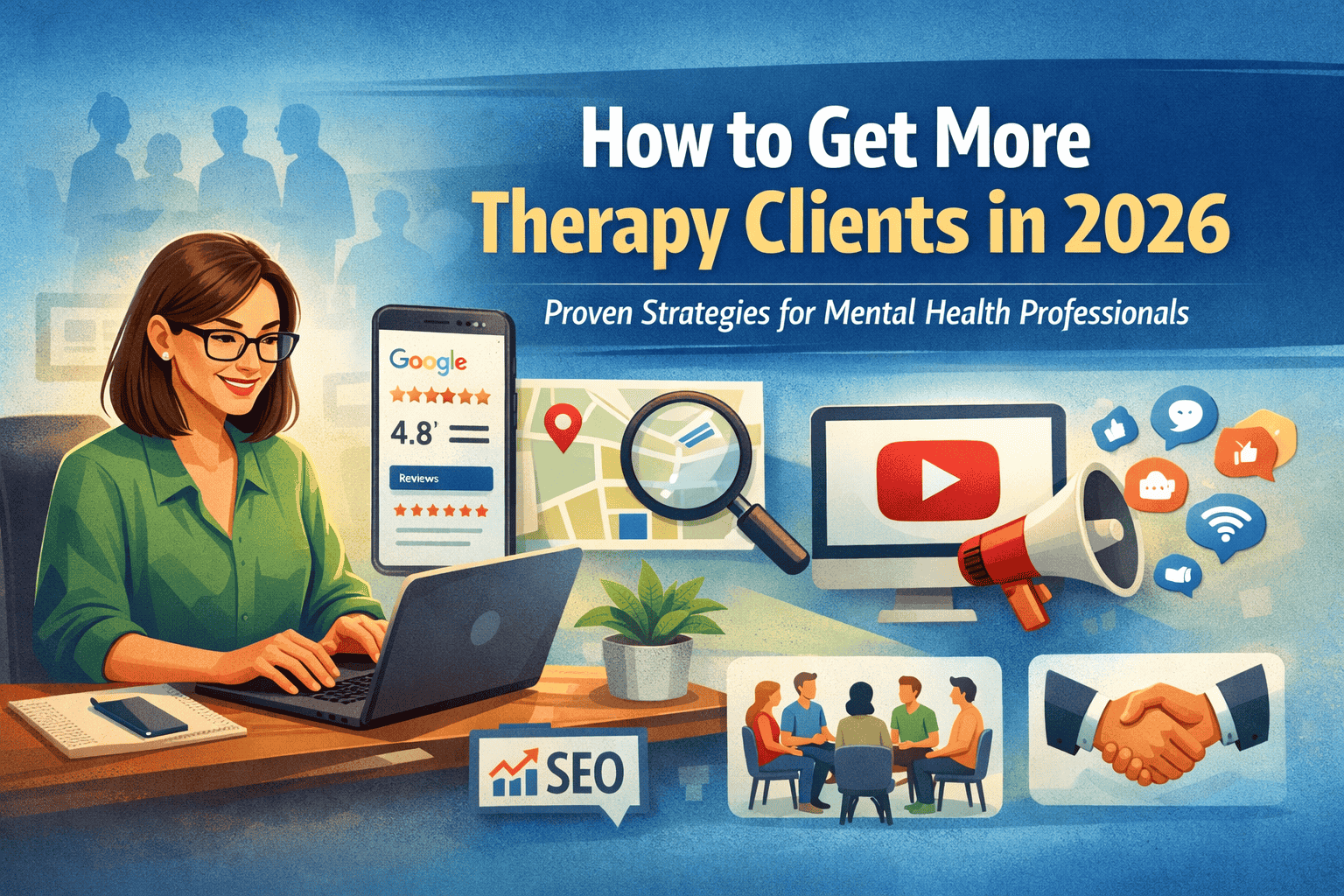
How do you get more therapy clients? The fastest results come from optimising your Google Business Profile, listing on Psychology Today and TherapyDen, building niche landing pages on your website, and asking for referrals from GPs and allied health professionals. For sustained growth, combine local SEO, consistent blogging, and a strategic online presence that reflects your specialist area.
Here's the uncomfortable truth most therapist marketing guides won't say: you can be brilliant at your job and still struggle to find clients.
Clinical skill and business growth are two entirely different muscles. The mental health space has never been more competitive demand is at an all-time high, but so is the number of practitioners. Directories are crowded. Algorithms keep shifting. "Just get on Psychology Today" isn't enough anymore.
This guide covers every strategy that actually moves the needle in 2026 from getting therapy clients fast to building the kind of compounding online presence that fills your calendar for years.
17 Strategy to Get Therapy Clients
1. Remarketing of Past Clients | Your Highest-ROI Activity
Of all 17 strategies in this guide, client reactivation costs the least and gets overlooked the most. People who have already worked with you know you, trust you, and have experienced results. A simple, warm email twice a year can generate immediate bookings.
Alos Read: Top therapy practice Management Software →"It's been a while since we last spoke. I just wanted to check in and let you know I'm here if you ever feel like talking again no pressure at all."
No sales pitch. No special offer. Just a genuine human touchpoint. You'd be surprised how many respond with "actually, I've been meaning to get back in touch."
Set a calendar reminder for six and twelve months after each client's last session. Make it a habit it's one of the highest-ROI activities in private practice.
2. Google Business Profile | Get Therapy Clients Near You
Most therapists claim their Google Business Profile and stop there. That's leaving serious visibility on the table. When someone searches "therapist near me" or "anxiety therapist in Manchester", the practices with the most complete profiles and highest-rated reviews dominate the local map pack the most clicked section of the results page.
How to Optimise Your Profile for Maximum Visibility
- Complete every field services, description, opening hours, website URL, photos
- Add your specialties as service categories "CBT," "Trauma Therapy," "Couples Counselling"
- Upload at least 10 photos your office, headshot, and branding build trust before first contact
- Reply to every review within 48 hours Google reads this as an active, credible business
- Post a monthly update or resource Google Posts keep your profile fresh
How to Collect Reviews Ethically as a Therapist
GDPR and professional ethics codes make this nuanced, but it's absolutely doable. You cannot solicit reviews from current or former clients. However, you can ask:
- Colleagues and supervisors who've observed your professional conduct
- Professional peers who've co-facilitated groups or workshops with you
- Referral partners who've seen how you handle their clients
3. Get Listed on the Right Directories (Not Just Psychology Today)
Therapist directories are often the first stop for someone actively searching for help. Cover the full map:
- Psychology Today the most recognised global directory; worth the fee
- TherapyDen free, values-led, growing fast
- Counselling Directory (UK) highly trusted by UK clients
- BACP Find a Therapist if you're BACP-registered, non-negotiable
- Apple Maps and Bing Places broader reach, especially for older demographics
- Nextdoor hyper-local referrals from people in your catchment area
NAP Consistency: The Silent SEO Factor
NAP stands for Name, Address, and Phone number. If your practice is listed differently across directories, Google sees inconsistency and inconsistency erodes algorithmic trust. Audit every directory and make your NAP identical across all platforms. This single fix can improve your local ranking noticeably.
4. Setup Therapy Website: The Foundation of Everything
Your website isn't a digital brochure. It's your most powerful client acquisition tool and most therapy websites are leaving serious business on the table. If you wants to get more therapy clients online A well-built therapy website should rank on Google for your specialty and location, convert visitors into enquiries within seconds, and book consultations automatically without phone tag.
Niche Landing Pages: The Strategy Most Therapists Skip
Here's a scenario that plays out constantly: a client searches "EMDR therapist for trauma in Leeds" and lands on a homepage that says "compassionate, holistic support for a range of issues." They don't see themselves. They bounce.
A dedicated landing page for EMDR therapy for trauma in Leeds would have kept them and converted them. Create individual pages for each of your core specialties, each written in the language your clients use:
- Anxiety and panic attacks
- Trauma and PTSD therapy
- Couples and relationship counselling
- Bereavement and grief therapy
- LGBTQ+ affirming therapy
- Postpartum mental health
- Veterans and military families
- Teens and adolescents
5. Local SEO for Therapists: Rank Higher in Your Area
Local SEO is the discipline of appearing in search results when people in your area search for therapy. It's a layered system and most therapists only scratch the surface with a Google Business Profile.
Schema Markup: Your Secret SEO Weapon
Schema markup is structured code that tells Google exactly what your business is. For therapists, you want both LocalBusiness and MedicalBusiness schema. It takes an hour to implement and dramatically improves your chances of appearing in rich results, knowledge panels, and AI-generated answers.
Location-Specific Content
Create blog posts and pages that reference your local area: "Finding a therapist in Bristol: what to look for" or "Anxiety therapy in Edinburgh how to take the first step." These long-tail location pages are low-competition and highly targeted.
Also Read Local SEO for Healthcare Professionals The Complete Guide → Explore Healthcare SEO Services Rank Higher, Get Found Faster →6. Blogging: Your 24/7 Client Acquisition Engine
A well-maintained blog works while you sleep ranking in Google, answering the exact questions your ideal clients are typing, and building the trust that converts a curious reader into an enquiry.
What to Write About
Use Google's "People Also Ask" boxes and search autocomplete to find real questions. For a therapist specialising in anxiety, high-value topics include:
- "Signs you have high-functioning anxiety"
- "What's the difference between therapy and counselling?"
- "How to find the right therapist for you"
- "What happens in the first therapy session?"
- "How to find a therapist who takes insurance"
7. YouTube: The Most Underused Channel in Therapy Marketing
YouTube is the second-largest search engine in the world, and almost no therapists are using it strategically. When someone types "what happens in the first therapy session" into YouTube, they're often on the edge of booking they need a nudge, some reassurance, and a human face they can connect with.
- "What to expect in your first therapy session" reduces the fear of the unknown
- "Signs you might benefit from therapy" targets people at the consideration stage
- "How to find the right therapist for you" positions you as a trusted guide
- Myth-busting videos "Therapy isn't just for crisis situations"
YouTube videos regularly appear in Google search results too. A well-optimised video can rank on both platforms simultaneously doubling your visibility for zero extra effort. Film once, repurpose everywhere: Instagram Reels, LinkedIn clips, podcast audio, blog content.
Growth Strategy for Therapists: Building Long-Term Referral Pipelines
8. Strategic Partnerships: Beyond the Obvious Referral Network
Every guide tells you to network with GPs and psychiatrists. Yes do that. But the therapists who fill their caseloads fastest are those building referral pipelines others haven't thought of yet.
High-Value Medical Partnerships
- OB-GYNs and midwives see postpartum patients every day; one relationship generates consistent monthly referrals
- Oncologists and palliative care teams regularly encounter patients in psychological distress with no integrated support
- Paediatricians the gatekeepers for child and adolescent mental health
- Divorce attorneys and family lawyers their clients are in crisis; a referral positions the lawyer as holistic and caring
- HR departments and EAP providers direct revenue with consistent weekly referrals
- Gyms, yoga studios, and wellness centres clients already investing in wellbeing are warm prospects
- Churches and faith communities often underserved, with strong referral loyalty once trust is established
- Funeral homes grief counselling referrals from funeral directors are genuine and virtually untapped
9. Online Communities: Build Authority Where Your Clients Already Are
You don't have to wait for Google to rank you. There are communities full of your ideal clients actively asking questions you're qualified to answer right now.
- Subreddits like r/mentalhealth, r/anxiety, and r/therapy have millions of members
- Build genuine presence by answering questions thoughtfully
- Over time, that presence creates authority and direct messages
- A well-written answer ranks on Google and gets read for years
- Low-effort, high-longevity content with no algorithm to beat
- Great for evergreen authority building
- Nextdoor generates warm, hyper-local referrals
- LinkedIn is powerful for EAP referrals and corporate wellbeing contacts
- When someone asks "recommend a good local therapist?" your name needs to come up
10. Become a Media Expert: Authority at Scale
Being quoted in an article, featured on local TV, or published in a respected mental health publication does something directories can't: it creates perceived authority at scale. One Psychology Today contributor article can generate enquiries for years. One local news appearance positions you as the go-to expert in your area.
- Local newspapers always looking for expert commentary; email the health editor directly
- Connectively, Qwoted, and Featured.com send daily journalist requests looking for expert sources
- Psychology Today's contributor programme open to licensed professionals; commit to one article per month
- Local podcasts and radio shows mental health is a perennially popular topic; pitch thoughtfully
11. Schools, Universities & Workplaces: Referral Pipelines for Life
University counselling services are overwhelmed. When they can't see a student, they need someone to refer them to. Reach out to your local university counselling centre and offer to be a trusted overflow provider. The same logic applies to:
- Graduate psychology and social work programmes students regularly encounter clients they can't take on
- Nursing programmes those graduates go on to work in GP practices and community settings
- High schools mental health awareness sessions generate parent referrals
- Corporate HR teams workplace wellbeing is a growing procurement category
These relationships take time to build. But once established, they refer consistently, year after year, with zero ongoing marketing effort.
12. Group Therapy & Workshops: Scale Your Impact
A single 90-minute group session can serve six to eight clients simultaneously. A free webinar can attract 40 people some of whom book individual therapy, buy a course, or refer a friend.
Branding Strategy for Therapists: Stand Out in a Crowded Market
Your brand is what makes an ideal client choose you over a dozen similar practitioners. It's not a logo it's how you make people feel before they've even spoken to you.
13. Your Professional Bio: Marketing That Works Around the Clock
Across every platform your website, directories, LinkedIn, Psychology Today your professional bio is doing selling work 24 hours a day. Most therapist bios read like CVs. The best bios do three things:
- Establish credibility (qualifications matter)
- Demonstrate understanding of the client's problem not just your solution
- Give a glimpse of your personality and approach
Write in first person. Speak to the client you most want to help. Use the language they use to describe their own experience.
14. Branding Strategy for Therapists With Waitlists
A waitlist isn't just an administrative inconvenience. In the right hands, it's a powerful brand asset. A visible waitlist on your website signals one thing: this therapist is in demand. That's social proof without spending a penny.
How to Nurture Your Waitlist Strategically
- Send a welcome email acknowledging their wait and expressing genuine care
- Share a free resource a guided breathing exercise, self-assessment tool, or blog post
- Check in every 2–3 weeks with something genuinely useful
- Offer a group programme as an interim option
By the time a slot opens, a nurtured waitlist client is already emotionally invested in working with you specifically. Retention before the first session has already begun.
15. How to Attract Private Pay Therapy Clients Specifically
If you're building a private pay practice without relying on insurance panels, the strategy shifts slightly. Private pay clients are investing at a premium they need to feel confident you're the perfect fit.
- Niche deeply private pay clients often pay more for someone who feels like the perfect match for their specific issue
- Build social proof testimonials (where ethically appropriate), media features, and strong directory profiles all signal credibility
- Price with confidence underpricing signals uncertainty; private pay clients often associate higher fees with higher quality
- Offer a free 15-minute consultation reduce the financial risk of the first step
- Create content that speaks to their world a burned-out executive responds to different content than a student in crisis
Advanced Strategies: Paid Ads & AI Discoverability
16. Paid Advertising: How to Do It Right
Paid advertising gets a bad reputation in therapy circles because most therapists try it once, spend £100 with no clear strategy, see no results, and conclude it doesn't work. The channel isn't the problem. The approach is.
- Highest-intent traffic available people are actively searching and ready to book
- £150–300/month is enough for a meaningful local campaign
- Always send traffic to a dedicated landing page, never your homepage
- Builds awareness with people who don't know they're looking yet
- Retargeting is the real power reach people who visited your site but didn't book
- Effective for webinar promotion and free resource lead generation
- Reaches people already engaged with mental health content
- Even 15-second non-skippable ads build brand recognition
- Test, measure, iterate ads are data, not failures
17. Get Found by AI: The New Frontier in Client Acquisition
Clients are increasingly turning to ChatGPT, Claude, Gemini, and Perplexity not just to search but to get recommendations. "Find me a therapist in London who specialises in OCD." These AI systems pull answers from structured, credible, well-organised content across the web.
- Write in Q&A format where possible AI loves pulling direct question-and-answer pairs
- Add FAQ sections to every key page on your website
- Use clear headings that match real search queries ("What is EMDR therapy?" not just "EMDR")
- Define your terms AI systems favour content with authoritative, clear definitions
- Be factually precise vague or fluffy content is ignored by both Google and AI
Use AI to Scale Your Own Marketing
Beyond being discovered by AI, use it to produce more marketing content faster. Draft blog posts, social captions, and email newsletters in a fraction of the usual time. Repurpose one video transcript into ten different content formats. Add an AI chatbot to your website to handle after-hours enquiries.
Also Read AI in Healthcare Marketing What's Changing in 2026 →Treat Your Intake Process as a Marketing Tool
Your intake process is the first experience a prospective client has of actually working with you. Most practices treat it as administrative formality. It's actually a conversion and retention opportunity.
- Online booking no phone tag, no waiting for a callback; frictionless booking increases conversion
- Instant confirmation email acknowledges their courage in reaching out and tells them what to expect
- A short "what to expect in your first session" video this single touchpoint can dramatically reduce anxiety-driven cancellations
- Paperless intake forms completed before the appointment reduces friction on both sides
- Pre-session check-in email a gentle reminder with practical logistics lowers no-show rates
Your 90-Day Action Plan: Where to Start
Lay the Foundation
- Claim & fully complete Google Business Profile
- List on TherapyDen, Counselling Directory, Bing Places
- Send reactivation email to past clients
- Overhaul intake add online booking & welcome email
- Sign up for Connectively or Qwoted
Go Deeper Online
- Build 2–3 niche specialty landing pages
- Reach out to 2 strategic partners
- Publish first SEO-focused blog post
- Audit NAP consistency across all directories
- Add LocalBusiness schema to your website
Build Compounding Channels
- Launch YouTube with 3 foundational videos
- Run a free monthly webinar
- Start a Google Ads test campaign (£5/day)
- Begin building an email list via a free resource
- Pitch to one local podcast or media outlet
Frequently Asked Questions
Looking for expert support building your therapy practice's online presence? Explore Healthcare IT Solutions specialists in web design for therapists, healthcare SEO, social media marketing, and content marketing built specifically for healthcare professionals.