You've probably come across Psychology Today at some point.
Maybe a client mentioned finding you there. Maybe you're wondering whether to list your practice on their directory. Or maybe a colleague shared one of their articles and you're not sure how much to trust it.
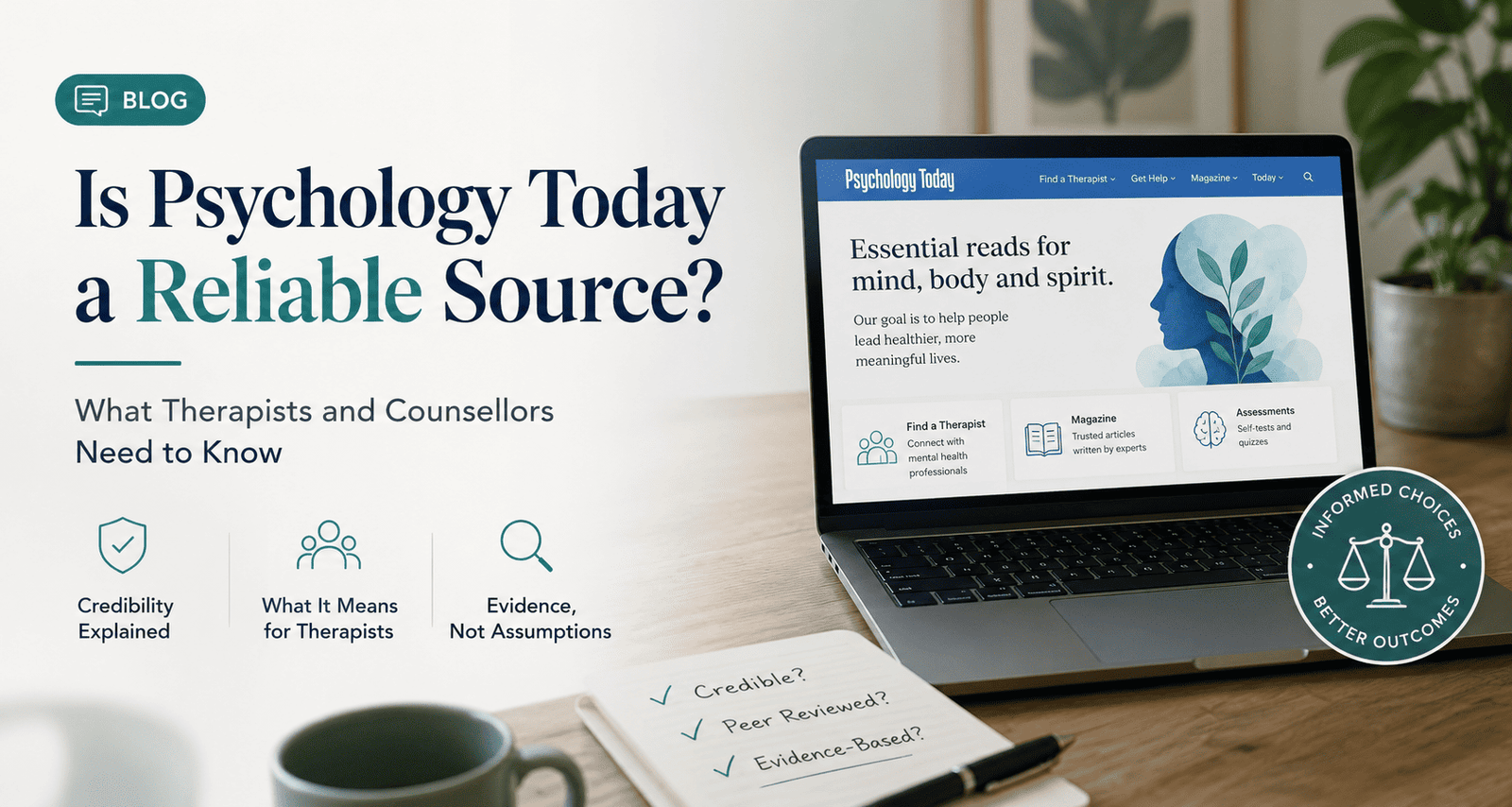
Either way, you've got one big question: Is Psychology Today actually a reliable source?
In this guide, you'll get a straight answer no vague disclaimers, no fence-sitting. You'll learn exactly what Psychology Today is, whether it's peer-reviewed, how credible its content really is, and whether it's worth your time as a therapist or counsellor.
What Is Psychology Today?
Psychology Today is one of the most visited mental health websites in the English-speaking world. It was founded in 1967 as a print magazine in the United States. Today, it operates primarily as a digital platform with millions of readers every month.
But here's where most people get confused: Psychology Today is not just one thing. It's actually three things rolled into one:
Alos Read: Top therapy practice Management Software →Is Psychology Today a Magazine, a Journal, or a Blog?
Short answer: it started as a magazine. Today, it's best described as a digital mental health media platform. Here's how the main formats compare:
| Format | Who Writes It | Review Process | Primary Purpose |
|---|---|---|---|
| Peer-Reviewed Journal | Researchers & academics | Independent expert review | Advance academic knowledge |
| Psychology Today | Licensed professionals & contributors | Internal editorial team | Public mental health education |
| General Blog | Anyone | Often none | Personal perspective sharing |
Psychology Today sits firmly in the middle category expert-informed content aimed at general readers, not original research for academics. That's an important distinction, and we'll come back to it.
Who Publishes Psychology Today and What Do They Produce?
Psychology Today is published by Sussex Publishers, LLC, based in New York. It has been running since 1967 making it one of the longest-standing mental health publications in the world. The website publishes new content daily across three content types: articles written by vetted contributors, therapist directory listings, and self-assessments.
Also Read Best Online Directories for Therapists →Is Psychology Today a Credible and Legitimate Source?
Let's get to the question you actually came here for.
Yes Psychology Today is a credible and legitimate source. But there are important caveats, and understanding them will help you use it correctly.
Alos Read: Top therapy practice Management Software →- Contributors are typically licensed mental health professionals
- Editorial team reviews content before publication
- Nearly 60 years of continuous operation
- No anonymous publishing permitted
- Widely recognised across the UK and US
- Not peer-reviewed by independent experts
- Not suitable as an academic or scholarly citation
- Content quality varies by individual contributor
- No independent fact-checking process
- Not a substitute for clinical research sources
Is Psychology Today Peer Reviewed?
No. Psychology Today is not peer reviewed. This is probably the single most important thing to understand about the platform.
Peer review means independent experts scrutinise a piece of research before it's published checking methodology, data, and conclusions. It's the gold standard of academic publishing. Psychology Today does not go through this process. Articles are reviewed by an internal editorial team, but they are not independently validated by outside researchers the way a journal article would be.
Is Psychology Today a Scholarly or Academic Source?
No Psychology Today is not a scholarly or academic source. If you're a student writing an essay or dissertation, Psychology Today should not be your primary citation. You'll want to cite the original peer-reviewed studies that Psychology Today articles reference not the articles themselves.
| Psychology Today | Peer-Reviewed Journal | |
|---|---|---|
| Written by | Licensed professionals & contributors | Researchers & academics |
| Reviewed by | Editorial team | Independent expert reviewers |
| Purpose | Public education | Academic knowledge |
| Citation suitability | General reference only | Academic papers |
| Examples | psychologytoday.com | JAMA, The Lancet, PLOS ONE |
Who Writes for Psychology Today and How Are They Vetted?
This is where Psychology Today earns a lot of its credibility. Most contributors are licensed therapists, psychologists, or psychiatrists, university-affiliated researchers, or practitioners with published books in their specialism. Psychology Today reviews contributor applications before approving them assessing credentials, areas of expertise, and writing quality.
How Reliable Is Psychology Today for Different Readers?
Here's the honest answer: it depends on who you are and what you're using it for. Psychology Today is genuinely reliable for some purposes and the wrong tool for others.
Yes reliable. Every therapist listed must submit professional credentials, which Psychology Today verifies before approving a listing. Profiles include specialisms, therapeutic modalities, fees, and location. For UK-based searches, Psychology Today has a dedicated UK directory with geographically relevant listings.
Genuinely useful in two areas: the directory has real reach and generates consistent enquiries; the contributor platform lets you publish under your own name, building personal brand and search visibility. Best used as one channel alongside a dedicated website you own.
Use it carefully. It's a reliable place to get a clear overview of a psychological concept and find references to actual studies which you should then track down and cite directly. Citing Psychology Today itself in an academic paper is generally not recommended by most academic institutions.
- Sharing general mental health information with clients it's accessible, clear, and written by professionals.
- Explaining psychological concepts to a non-specialist audience ideal for patient education on a website or blog.
- Citing a practitioner's perspective not a research finding, but a professional viewpoint.
- Starting point for research use it to find original studies, then cite those instead.
- Avoid in academic or clinical research use primary peer-reviewed sources for formal work.
Is Psychology Today Worth It for Therapists and Counsellors?
This is the practical question for most people reading this. And the honest answer is: it depends on your goals and on what else you're doing to grow your practice.
What Therapists Can List on Psychology Today
- Your name, credentials, and professional photo
- Your specialisms and therapeutic approaches
- Location and session format (in-person, online, or both)
- Fee information
- A personal bio in your own voice
- A short video introduction
- A link to your own website
The Limitations of Relying Solely on Psychology Today
❌ The Risks of Renting Visibility
- You don't own your listing. If prices increase, the algorithm changes, or you cancel your subscription your visibility disappears overnight.
- High competition in major UK cities. In London, Manchester, and Birmingham, hundreds of therapists are listed in the same directory. Standing out is increasingly difficult.
- Traffic belongs to Psychology Today, not you. You're paying for access to their audience rather than building an audience of your own.
- No compound growth. A directory listing doesn't improve over time the way SEO does. You pay the same every month for the same visibility.
✅ Why a Dedicated Website Gives You More Control
- You own it completely. A professional website for therapists or counsellors is an asset you control no subscription, no algorithm changes that erase your visibility overnight.
- Ranks on Google for local searches. "Therapist in [your city]" or "counsellor for anxiety in [your area]" around the clock, without monthly fees.
- Builds over time. Healthcare SEO compounds every piece of content, every backlink, every optimisation makes the next month stronger than the last.
- Tells your full story. A website gives you space to communicate your approach, your values, and your specialisms in a way a directory profile never can.
Frequently Asked Questions About Psychology Today
Health eCommerce is one of the most rewarding and complex categories in digital commerce because the stakes are real. Your customers are trusting you with their health. Building a brand that earns and keeps that trust is not just good ethics it is the only sustainable competitive strategy in a market this large and this scrutinised.
If you're serious about building a sustainable client pipeline one that doesn't depend on renting visibility from a third-party platform your own website and an integrated healthcare marketing strategy built around your location and specialisms will serve you far better in the long run. That's exactly what we help therapists and counsellors do at Healthcare IT Solutions.
We design GDPR-compliant, high-converting websites for mental health professionals across the UK and back them with SEO strategies tailored to your specialisms and location. Book a free consultation → See how we can help your practice grow online.