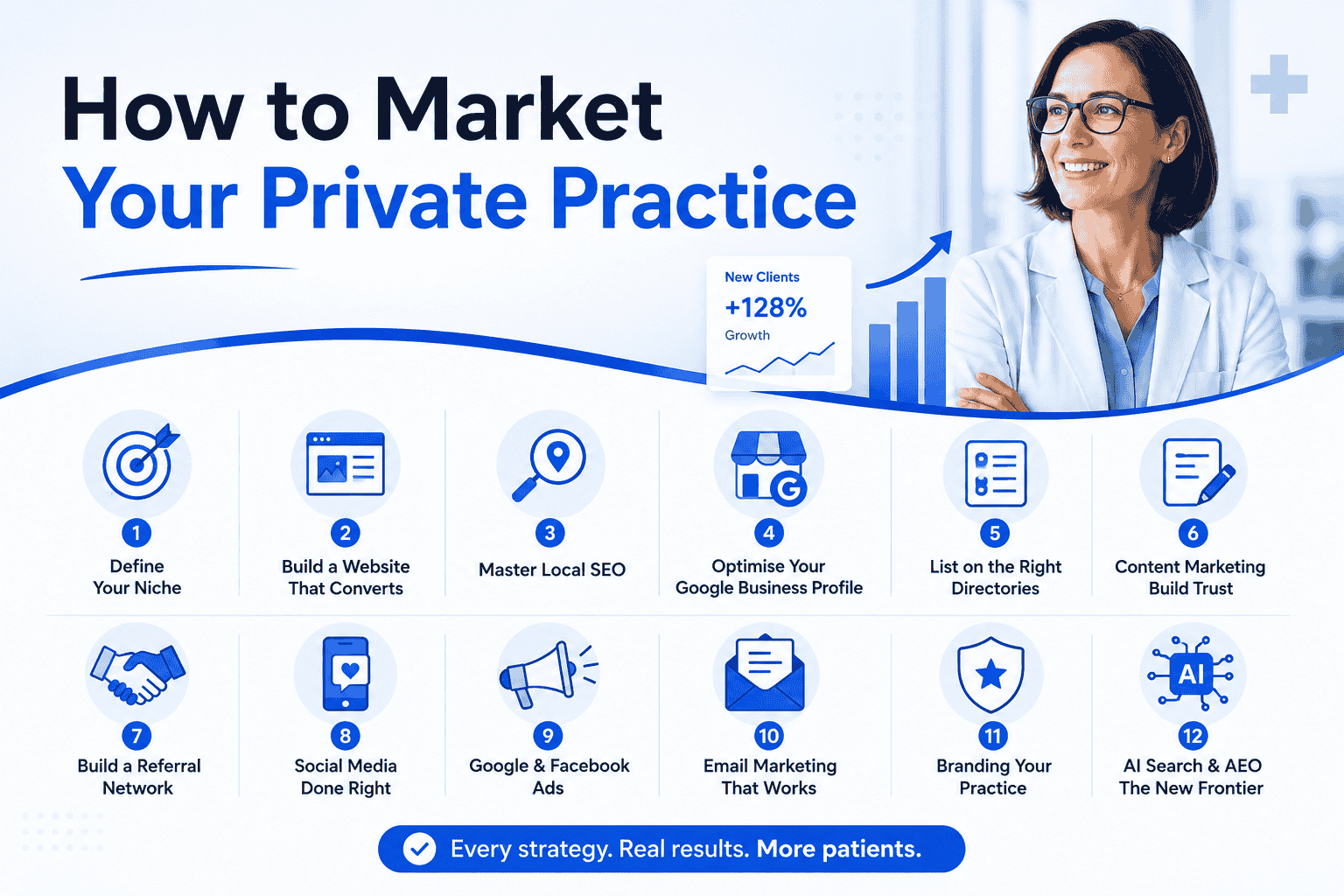
The demand for mental health services has never been higher. Median revenue for private practice therapists reached $80,412 in 2025 up from $68,222 the year before and two-thirds grew their revenue year-over-year (Heard, 2026). The therapists capturing that growth aren't necessarily the most qualified in their city. They're the most findable, the most trusted online, and the most consistent with their marketing. This guide gives you the framework to become one of them.
Strategy 1: Define Your Niche Before You Do Anything Else
Most therapists try to serve everyone. That's the fastest way to stand out to no one. A therapist who specialises in anxiety treatment for new mothers will attract more of the right clients than a generalist offering "therapy for adults" not because they're better, but because they're specific. Specificity builds trust before a prospective client ever contacts you.
Your niche shapes which directories you list on, which keywords you target, what content you create, and which referral partners make sense. Everything flows from it.
Alos Read: Top therapy practice Management Software →Look at Who You've Helped Most
- Which client type produced your best outcomes?
- Which sessions left you energised rather than drained?
- Your most effective work points directly to your natural niche
Check Real Local Search Demand
- Use Google Autocomplete to see what people actually search in your city
- "Therapist for anxiety London" vs "CBT therapist London" different volumes, different intent
- Base your niche on real demand, not assumptions
Pick One Primary Niche, One Secondary
- "Anxiety and trauma therapy for women in their 30s" is a niche
- "Therapy for adults" is not
- The more specific, the more your ideal client thinks: "this is exactly who I need"
Build Every Marketing Channel Around It
- Your website, directory profiles, content all speak directly to that specific person's specific problem
- Narrowing your niche increases client volume it doesn't reduce it
- A highly specific Psychology Today profile converts far better than a generic one
Strategy 2: Build a Website That Actually Converts Visitors Into Clients
Your website is your most important marketing asset and most therapy websites fail to convert because they're designed like brochures, not like tools. Even if word-of-mouth is your primary referral source, prospective clients will search you online before reaching out. If they land on a slow, generic, or unclear website they leave. The referral is lost.
- A clear headline that speaks to the client's problem not your credentials. "Feeling anxious and overwhelmed? I help busy professionals finally find calm." beats "Licensed Therapist, BACP Accredited."
- A professional photo of you above the fold. Therapy is deeply personal. Clients choose people. A warm, approachable headshot increases enquiry rates significantly.
- One clear call to action. "Book a Free 15-Minute Consultation." Not three options one. Reduce friction at every step.
- An About page that builds human connection. Clients want to know why you do this work, not just where you trained. Share your approach and your values.
- Mobile-first design. Over 60% of therapy website visitors arrive on mobile. If your site doesn't load fast and look clean on a phone, you're losing more than half your potential clients.
Strategy 3: Master Local SEO Get Found by Clients Already Looking for You
Local SEO is the highest-ROI marketing channel for private practice therapists. Done right, it brings clients to you passively every day, without ongoing ad spend. When someone in your city types "anxiety therapist near me" or "CBT therapist Manchester," Google shows a local results pack. Getting into those results is the single most valuable marketing action a private practice can take.
- Include location + specialty in page titles and headings
- "Anxiety Therapy in Leeds [Your Name]" tells Google exactly who to show your page to
- Every service page needs this, not just the homepage
- Create a dedicated page for each service you offer
- One page for CBT, one for trauma therapy, one for couples counselling
- Each targeting specific search terms not one generic "services" page
- Build citations consistently across directories
- Practice name, address, and phone number must be identical everywhere
- One inconsistency across 50 directories can suppress your ranking
Strategy 4: Optimise Your Google Business Profile Your Free Local Visibility Tool
Most therapists claim their Google Business Profile and leave it half-empty. That's leaving free, high-intent visibility on the table. Your GBP is free to create and appears directly in Maps and local search results. When a prospective client searches for a therapist nearby, a fully-optimised profile shows your photo, reviews, specialties, booking link, and hours before they've even visited your website.
- ✓ Claim and verify your profile at google.com/business
- ✓ Select the most specific business category "Mental Health Service" or "Psychotherapist"
- ✓ Write a compelling 750-character description including your specialty and location
- ✓ Add at least 10 high-quality photos your therapy space, headshot, and exterior
- ✓ List every service you offer with individual descriptions so Google can match you to specific searches
- ✓ Add a booking link directly to your online scheduling tool Google rewards direct action
- ✓ Post a short weekly update a mental health tip, an availability notice, or a FAQ answer
After a client completes their treatment and expresses satisfaction, send a simple email: "I'm so glad our work together was helpful. If you're willing, a Google review would mean a lot and help others in a similar situation find support."
Strategy 5: List on the Right Directories Not Just Psychology Today
Directories are passive income for your practice. Once your profile is live and optimised, it sends you clients around the clock with no ongoing effort. Psychology Today is the most visited therapy directory globally but it's also the most saturated. The smarter strategy is to diversify across multiple directories, each serving a different audience segment.
| Directory | Region | Cost | Best For |
|---|---|---|---|
| Psychology Today | UK & USA | ~£25–29/mo | High-volume general searches |
| Counselling Directory | UK | £29–99/mo | UK counsellors & therapists |
| BACP Directory | UK | With membership | Credibility with accreditation |
| NCPS Find a Counsellor | UK | With membership | PSA-recognised credibility |
| Welldoing.org | UK | Paid | Warm, matched enquiries |
| TherapyDen | USA | Free | Identity-affirming searches |
| Zencare | USA | Varies | Premium video-verified profiles |
| Grow Therapy | USA | Free | Insurance clients |
Strategy 6: Content Marketing Build Trust Before a Client Ever Contacts You
Content marketing isn't about selling. It's about being the most helpful, trustworthy voice in the room before a potential client is ready to reach out. When someone is considering therapy, they research. They read. They look for a voice that feels safe and understood before they take the vulnerable step of reaching out.
Strategy 7: Build a Referral Network That Sends You Clients Consistently
Referrals remain the most trusted source of new therapy clients and building a network doesn't require awkward cold outreach. Clients who arrive via referral are already pre-sold on trust. They have a lower dropout rate, higher session frequency, and are more likely to refer others themselves.
Connect with therapists who have full caseloads or adjacent specialties. A couples therapist with a waitlist is a goldmine for individual therapy referrals if they know and trust you. These relationships are the most immediately productive referral source.
GPs are often the first point of contact for patients experiencing mental health difficulties. A brief, professional introduction in person or by letter explaining your specialty and referral process can result in a consistent stream of referred clients month after month.
Yoga studios, physiotherapists, acupuncturists, nutritionists, and life coaches serve overlapping client populations. The clients of a mindfulness instructor are often excellent candidates for therapy and vice versa. These partnerships are underused and often very fruitful.
Strategy 8: Social Media Marketing for Private Practice Done Right
Social media is not about posting daily. It's about showing up with genuine value in the places your ideal clients already spend time. Most therapists either ignore social media entirely or burn out trying to maintain multiple platforms. Neither approach works. The effective strategy is to pick one platform that fits your niche and show up consistently with content that genuinely helps.
| Platform | Best For | Content Style |
|---|---|---|
| Therapists, life coaches, wellness professionals | Infographic tips, short Reels, patient education carousels | |
| Corporate psychologists, EAP therapists, psychiatrists | Thought leadership, professional insights, CPD sharing | |
| Therapists targeting 35–55 age group, family therapy | Long-form posts, community groups, event promotion | |
| TikTok / YouTube Shorts | Therapists targeting under-35s | Educational short-form videos, myth-busting, destigmatisation |
What to Post
- Educational content that helps your specific niche audience
- "3 signs you might have high-functioning anxiety" gets shared widely
- Every post should speak directly to the specific person you serve
- Post 2–3 times per week consistency over 90 days creates compounding results
- Use your niche as the filter for every single piece of content
What Not to Post
- Promotional content that asks people to book it doesn't convert
- "Book a session with me this week" this rarely works on social
- Content on platforms where your clients don't spend time
- Random posts with no connection to your niche or audience
- Inconsistent posting 5 posts then silence worse than no strategy
Strategy 9: Google & Facebook Ads When You Want Results Fast
Paid advertising is the accelerator not the foundation. Use it once your website and landing pages are ready to convert the traffic you pay for. The most common failure: a therapist spends £500/month on Google Ads, sends all traffic to their homepage, gets no enquiries, and concludes "ads don't work." The ads worked. The landing page didn't.
Target searches like "anxiety therapist [your city]", "CBT therapy [your area]", "online therapy for depression." Each ad must link to a dedicated landing page for that specific service not your homepage. A specific landing page for anxiety therapy will convert 3–4× better than a generic homepage.
Better for awareness and education than direct booking. Use video content (a 30-second introduction to your approach), lead forms (download a free anxiety guide in exchange for an email), and retargeting (showing ads to people who visited your website but didn't enquire).
Strategy 10: Email Marketing The Most Underused Tool in Private Practice
Email is the highest-ROI owned marketing channel available and almost no private practice therapists use it strategically. Most therapists treat email as a one-way appointment reminder tool. Done properly, it's a relationship maintenance system that generates reactivations, referrals, and ongoing community trust.
Strategy 11: Branding Your Private Practice Why It's Not Just a Logo
Your brand is the feeling a prospective client gets from every touchpoint with your practice before they've spoken a single word to you. A prospective client who is considering therapy is often in a vulnerable place. Everything about how your practice presents itself either increases or decreases their willingness to take that first step.
Consistent colours, fonts, and photography style across your website, social media, and printed materials. Calm, warm colour palettes greens, soft blues, earthy tones consistently outperform clinical whites and greys in therapy practice contexts. Your visual identity should signal safety before a word is read.
Write the way you speak in your first session warm, non-judgemental, clear. Avoid clinical jargon. "I help people who are struggling with anxiety find their way back to feeling like themselves" resonates more than "evidence-based CBT interventions for anxiety spectrum disorders." Your copy should feel like a conversation, not a clinical form.
Why do you do this work? Clients choose therapists they feel connected to. A brief, genuine origin story on your About page builds human connection before the first contact. And consistency matters: your website, Google Business Profile, directory listings, and social media should all feel like the same practice. Inconsistency creates uncertainty and uncertainty stops people from reaching out.
Strategy 12: AI Search & AEO The New Frontier of Private Practice Visibility
ChatGPT, Google AI Overviews, Perplexity, and Claude are now answering the questions your potential clients used to search Google for. When someone asks "what should I look for in a therapist for anxiety?" or "how do I find a good CBT therapist in London?" the answer comes from content across the web. If your website contains clear, authoritative, structured answers to those questions, your practice can be cited in those responses.
This is Answer Engine Optimisation (AEO) and it's rapidly becoming the most important new channel in healthcare marketing.
- Write FAQ content that directly answers questions. "What is CBT therapy?" "How many sessions will I need?" "What's the difference between a counsellor and a psychologist?" Structured Q&A content is exactly what AI systems pull from.
- Use schema markup on your website. Adding FAQ schema, LocalBusiness schema, and Person schema helps AI systems understand and accurately cite your content.
- Build authoritative backlinks. AI systems like ChatGPT and Perplexity draw from high-authority sources. Getting cited in professional body websites, reputable mental health publications, and established directories increases the likelihood of your content being referenced in AI responses.
- Keep your information consistent everywhere. AI systems cross-reference multiple sources. Consistent practice name, address, specialty, and qualifications across every directory and online profile signals credibility to both AI and human searchers.
Frequently Asked Questions
Marketing a private practice doesn't have to feel pushy or overwhelming. The strategies in this guide work precisely because they're built around being genuinely helpful and consistently visible not around selling. Start with the five quick wins this week. Build from there. The practices that show up consistently for their ideal clients always win in the long run.
If you'd like specialist support building the digital foundation website, SEO, content strategy, or paid advertising our healthcare marketing team works exclusively with healthcare providers and understands the specific compliance, sensitivity, and trust requirements of mental health marketing. Book a free strategy call and we'll show you exactly where your practice has the biggest opportunities.