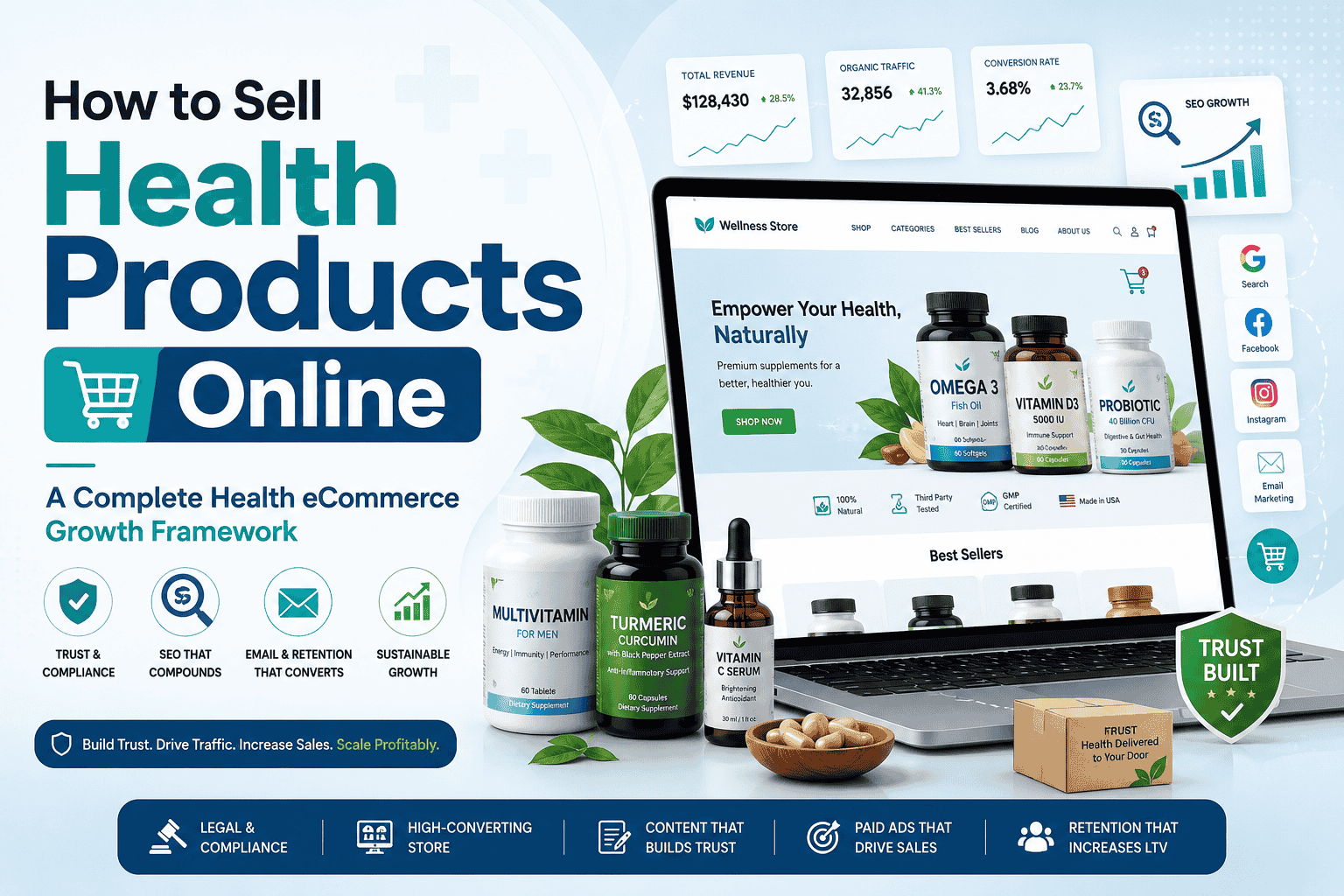
Why Health eCommerce Is the Strongest Online Market
The global wellness industry is projected to exceed $7 trillion by 2026 and online channels are capturing an increasing share of that spend. Consumers are shifting their health purchasing from physical retail to digital-first, driven by convenience, product variety, and the ability to research ingredients, reviews, and certifications before buying. This is not a niche opportunity. It is one of the largest and fastest-growing consumer categories in the world.
What makes health products particularly attractive for online sellers is the repeat-purchase dynamic. A customer who finds a supplement, skincare product, or wellness tool they trust doesn't just buy once they subscribe, reorder, and refer others. Customer lifetime value in health eCommerce consistently outperforms general eCommerce when brands invest in post-purchase trust and retention.
Alos Read: Top therapy practice Management Software →| Category | Market Size (2025) | Growth Rate | Repeat Purchase Rate |
|---|---|---|---|
| Dietary Supplements (USA) | $68.74B | 8.5% CAGR | Very High |
| Wearable Technology | $203B | 13.21% CAGR | High |
| Mental Wellness (apps + products) | $83.64B | 17% CAGR | High |
| At-Home Fitness Equipment | Growing | 8.21% CAGR | Medium |
| Natural Skincare & Personal Care | $37.97B (US) | 8.5% CAGR | Very High |
| Sleep Support Products | $83.64B | Strong | High |
Choose the Right Niche Before You Source a Single Product
The health product market is vast. The brands that win own a specific corner of it not the whole thing. A brand selling "health supplements" competes with thousands. A brand selling "adaptogen blends for women over 40 managing stress and sleep" competes with dozens. The narrower your niche, the lower your customer acquisition cost, the stronger your brand identity, and the more loyal your customer base.
- Use Google Trends: Confirm search volume is growing, not declining. A declining trend means you're entering a shrinking market regardless of how good your product is.
- Search your keywords on Amazon: Note the number of reviews on top products high review counts mean strong demand AND established competition. Find the gap in negative reviews.
- Identify the complaint gap: What do buyers complain about in existing product reviews? Poor taste, inadequate dosage, lack of third-party testing, confusing claims. That gap is your product positioning.
- Seasonal vs evergreen: Immune boosters spike in winter. Protein supplements and vitamins have consistent year-round demand. Understand the demand curve before planning inventory and marketing spend.
- Check repeat purchase potential: Supplements, skincare, and consumables have natural repurchase cycles. One-time purchase products have fundamentally different economics.
Legal & Compliance Foundations You Cannot Skip
Health products are not like selling clothes. The regulatory environment is strict and getting it wrong costs more than getting it right from the start. Every health product category has its own regulatory framework. Getting these foundations right before launch is not optional.
- Dietary supplements: cGMP manufacturing standards
- No disease claims structure/function claims only
- Medical devices: FDA clearance by classification
- FTC governs advertising claims including testimonials
- Food supplements regulated under food law
- Medicinal claims trigger medicine classification
- Medical devices: UKCA marking post-Brexit
- ASA governs advertising claims in the UK
- Health claims must appear on EU approved claims register
- Novel food regulations for new ingredients
- CE marking for medical devices
- GDPR applies to all customer data handling
1. Making disease claims on supplement products. "Supports healthy immune function" is permissible. "Treats colds and flu" is a drug claim that invites enforcement action. Every word on your product listing matters.
2. Selling on platforms without meeting specific requirements. Amazon's Health & Personal Care category has specific listing requirements and certification demands. Violations result in listing suppression often without warning.
3. Labelling non-compliance. Labels must list all ingredients, allergens, net quantity, manufacturer information, and required warnings in the correct format. A non-compliant label can result in a product recall.
Build a Health eCommerce Store That Actually Converts
Most health product stores are built to look good. The ones that grow are built to convert and those are different things. Health product buyers are cautious. They are putting something into or onto their body, or trusting a device with their health data. Conversion rate on a health product store is therefore more dependent on trust signals than on design aesthetics or even price.
- Ingredient transparency and sourcing stories. Consumers buying health products want to know what's in the product, where it comes from, and how it was made. Brands that lead with full ingredient transparency and third-party testing results convert significantly better than those hiding behind marketing language.
- Clinical references and expert endorsements. A product page that cites peer-reviewed research for its key ingredients, or carries endorsement from a named healthcare professional, commands substantially higher trust than one relying solely on brand claims.
- Verified reviews volume and specificity. Generic five-star reviews carry less weight than specific, verified reviews describing a named health outcome. "My sleep quality improved measurably within two weeks" converts better than "great product, fast delivery."
- Clear subscription and returns policy. Health product buyers worry about being trapped in subscription programmes. A prominently displayed, genuinely flexible subscription policy (easy to pause or cancel) reduces purchase hesitation significantly.
- Mobile-first product pages. Over 65% of health product purchases now originate on mobile. Product descriptions, ingredient panels, and CTAs must be readable and functional on a small screen without zooming.
SEO for Health Products The Channel That Compounds
Paid ads stop the moment you stop paying. SEO keeps delivering and in a high-competition category like health products, organic search is often where the most profitable customers come from.
53% of all website traffic comes from organic search making SEO the single largest traffic channel available to eCommerce brands. In health specifically, buyers research extensively before purchasing, making educational SEO content disproportionately effective. A buyer who arrives via organic search after reading your educational content converts at a premium because they arrive informed and pre-sold. (Source: BrightEdge)
The Dual-Mode SEO Framework for Health Products
Transactional Mode Keywords
- Buyers know what they want search directly for it
- "Buy magnesium glycinate 400mg", "best collagen powder UK"
- High intent, high competition
- Target on product pages with optimised titles, descriptions, and schema
- These keywords convert immediately when the page earns trust
Research Mode Keywords
- Buyers are learning about their problem and searching for solutions
- "What causes poor sleep quality", "best supplements for gut health 2026"
- Lower competition, higher education value
- Target on blog content that links naturally to product pages
- These buyers arrive pre-sold conversion rates are higher
Content Marketing for Health Products Build Trust Before the Sale
The brands that dominate health eCommerce don't just sell products. They become the most trusted information source in their niche. Johnson & Johnson built BabyCenter a content platform serving 100 million parents before selling a single product to them. That is the content marketing principle at full scale.
Social Media Marketing for Health Product Brands
Social media in health eCommerce is not primarily an advertising channel. It is a trust-building channel that makes advertising work better. Hims & Hers grew to a $1.6 billion public company primarily by being the brand brave enough to name the health problems their audience was too embarrassed to search for. Their social content addressed the problem directly not the product features. The product was the solution. The problem was the hook.
Best for visual product education, before/after results, ingredient explainers, and destigmatisation content. Audience: 18–40, health-conscious, discovery-mode buyers. Short-form video consistently outperforms static posts in health categories on both platforms.
Best for long-form educational content, in-depth product reviews, expert interviews, and ingredient deep-dives. Audience: research-mode buyers who want depth before purchasing. YouTube content also surfaces in Google search results dual visibility benefit.
Facebook: community groups, retargeting, and audiences 35+. Strongest for products targeting older demographics or chronic condition management. LinkedIn: B2B health brands, practitioner-facing products, clinical or professional positioning healthcare professionals and wholesalers.
Paid Advertising for Health Products What Works and What Gets You Banned
Health product advertising has more restrictions than almost any other eCommerce category. Knowing the rules before you spend is not optional. Google Ads, Meta Ads, and TikTok Ads all restrict health product advertising to varying degrees. Understanding platform policies before building campaigns is the difference between profitable scaling and account suspension.
Focus on transactional keywords buyers who know what they want. Each ad must link to a dedicated landing page matching the ad's specific promise exactly. A campaign for "magnesium for sleep" must land on a page specifically about magnesium and sleep not your general product catalogue.
Brands that implemented service-specific landing pages saw a 528% increase in leads with a 12% reduction in ad spend (Hallam Agency). The same principle applies directly to health product landing pages.
Lead with video content showing a relatable problem, then the solution. Lead generation ads offering a free guide or assessment outperform direct product ads for cold audiences in health categories.
Retargeting campaigns targeting website visitors and abandoned carts consistently deliver the strongest ROAS in health eCommerce these audiences already know your brand and have demonstrated purchase intent.
Email & Retention Marketing Where Health eCommerce Profits Live
Customer acquisition in health eCommerce is expensive. Retention is where the economics improve and email is the primary retention tool. A supplement that genuinely improves someone's sleep, energy, or digestion creates a repeat buyer for life often across multiple products in your range.
Welcome Sequence (Days 1–7)
- Tell your brand story and explain the science behind your key ingredients
- Set expectations about when results are typically felt
- Customers who understand the product mechanism are significantly less likely to return it before giving it time to work
Usage Guidance Series (Days 7–30)
- Practical tips for getting the most from the product timing, dosage, complementary habits
- Brands that educate customers on product use see measurably higher satisfaction scores and lower return rates
- This is where trust is consolidated and the repeat purchase decision is made
Results Check-In (Day 28–30)
- Ask how the customer is finding the product
- Generates reviews, identifies at-risk customers before they churn
- Creates an opportunity to upsell complementary products based on their specific goals
Subscription or Reorder Prompt (Day 45–55)
- Timed to coincide with the point at which a first-time buyer is running low
- Frame as a genuine value offer a discount, a bonus product, or a subscription benefit
- Not just a transactional prompt a reason to continue that extends beyond price
Winback Campaign (90 Days Post-Last Purchase)
- For customers who haven't reordered a single well-crafted email acknowledging the gap
- Offer a genuine reason to return: a new product, new research, or a loyalty reward
- Reactivates a meaningful percentage of lapsed customers at very low cost
Building Trust at Scale The Sustainable Growth Lever
In health eCommerce, trust is not a marketing tactic. It is the product. Every brand decision either builds or erodes it. The health product brands that achieve sustainable scale are built on a foundation of genuine trust that manifests in five specific, measurable ways.
NSF International, Informed Sport, USP verification, and equivalent certifications are not just compliance boxes they are conversion tools. A product page displaying third-party testing certification and a Certificate of Analysis converts at meaningfully higher rates than an identical page without them, because they signal that an independent body has verified what the brand claims.
Consumers increasingly research where ingredients come from country of origin, farm practices, sustainability credentials. Brands that make this information findable and specific (not vague) convert better and attract better press coverage. "Sourced from certified organic farms in Peru" beats "premium natural ingredients" on every trust metric.
A medical advisor, registered dietitian, or clinical pharmacologist listed as a formulation consultant creates an instant credibility signal. A formal advisory relationship with a named, credentialled professional even part-time serves this purpose. Combined with responsive customer support (replies within hours, empathetic and knowledgeable), these signals build loyalty that no ad campaign can replicate.
Common Mistakes Health eCommerce Brands Make
❌ The Mistakes
- Making disease claims on product pages or ads. "Treats anxiety," "cures insomnia," "prevents cancer" drug claims that violate FDA and FTC regulations. Consequences include warning letters, forced listing removal, FTC fines, and product recalls.
- Sending paid traffic to a homepage. A customer who clicks an ad for "magnesium for anxiety" and lands on a general supplement store homepage will leave. The conversion cost is absorbed, the sale is lost.
- Ignoring post-purchase email entirely. Investing heavily in acquisition and nothing in retention is one of the most financially damaging priorities misalignments in eCommerce.
- Treating SEO as a one-time task. Publishing ten posts at launch and expecting sustained organic traffic is not a strategy. SEO compounds only when content is added consistently.
- Launching without a mobile-optimised product page. Over 65% of purchases originate on mobile. An illegible ingredient panel loses more than half your potential conversions.
✅ The Fixes
- Structure all claims as structure/function statements ("supports healthy sleep patterns") reviewed by a regulatory consultant before launch.
- Build a dedicated landing page for each paid campaign matching the ad's promise word for word. One landing page change can double conversion rate overnight.
- Build the five-email post-purchase automation sequence before scaling ad spend. Retention infrastructure pays for itself within weeks.
- Commit to a publishing cadence at minimum two pieces of educational content per month and treat it as a 12-month investment, not a 4-week project.
- Test your product page on three different mobile devices before launch. If ingredient information isn't immediately readable without zooming, redesign before spending a penny on traffic.
Frequently Asked Questions
Health eCommerce is one of the most rewarding and complex categories in digital commerce because the stakes are real. Your customers are trusting you with their health. Building a brand that earns and keeps that trust is not just good ethics it is the only sustainable competitive strategy in a market this large and this scrutinised.
If you're building a health product brand and want specialist support across SEO, content, paid advertising, and GDPR-compliant web design, our healthcare marketing team works exclusively with health and wellness brands. Book a free strategy call and we'll show you exactly where your brand has the biggest growth opportunities.